

Omoway’s Omo X introduces self-balancing tech and AI-assisted riding, transforming daily commutes with smarter, safer, and less exhausting mobility.
Subscribe to our Instagram Channel for instant news & updates!
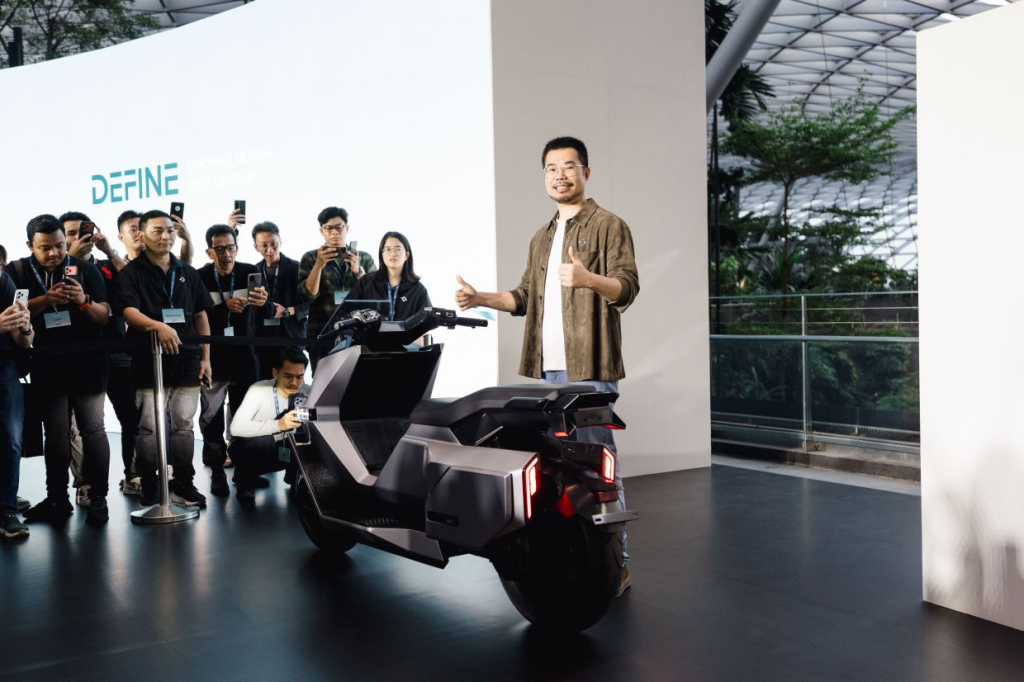
In a tech world where “innovation” often feels like a recycled buzzword, it’s rare to witness something that genuinely resets your expectations. But that’s exactly what happened at Omoway’s global launch in Singapore when the Omo X made its entrance: not with a roar, but with quiet confidence.
No rider. No wobble. No drama.
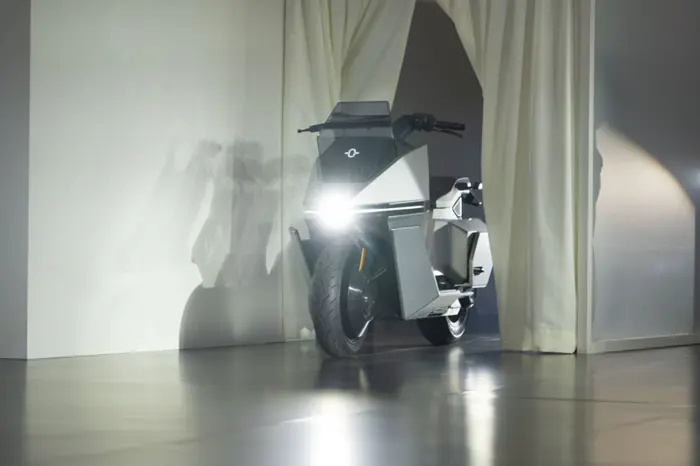
It simply rolled forward and stopped, perfectly upright, like it understood the moment. Then, almost as an afterthought, the kickstand dropped and the bike leaned gently into a resting position. It felt less like a machine being demonstrated and more like a glimpse into what mobility might look like when it starts thinking for itself.
The part nobody romanticizes about riding
Let’s skip the cinematic version of motorcycling for a second.
Because real life? It’s sweaty traffic jams, aching wrists, and the constant stop-start rhythm that turns your left foot into overworked machinery. If you’ve ever crawled through a packed city during rush hour or ridden through a sudden downpour, you know the truth: riding isn’t always freedom, it’s often fatigue.
That’s where the Omo X changes the conversation.
This isn’t about replacing riders or stripping away the thrill. It’s about giving you a choice. You want full control on an open road? Go for it. But when you’re stuck inching forward in suffocating heat, the bike can step in, balancing itself, stabilizing your ride, and taking the edge off the grind.
It’s less “autopilot” and more “co-pilot for the boring parts.”
So… how does it actually stay upright?
The magic isn’t magic. It’s engineering stacked with intelligence.
At the core is something Omoway calls the Omo-Robot Universal Architecture. Behind that name is a layered system that mimics human instincts in four ways:
- It sees using a full 360° camera system, constantly scanning and predicting movement.
- It thinks through AI trained on massive simulations, making split-second decisions.
- It acts by coordinating motors, brakes, and gyroscopic forces to keep everything stable.
- It reacts instantly, with near-zero delay between detection and response.
The real star, though, is the Control Moment Gyroscope (CMG), a piece of tech borrowed from satellites and ships. Think of it like an invisible core muscle that keeps the bike balanced, even when physics says it shouldn’t be.
The result? A motorcycle that can correct itself on slippery roads, stabilize through turns, and even help avoid obstacles before you fully register them.
A machine that doesn’t just ride, it learns
Here’s where things get even more interesting.
The Omo X isn’t static. It evolves.
Before it ever hits the road, it’s already lived thousands of lives in simulation, learning from virtual traffic, weather, and terrain. But the real-world learning doesn’t stop after purchase.
If one bike encounters a tricky situation (say, a sudden skid on an oil patch) it records that moment. That data gets sent to the cloud, recreated digitally, and analyzed. Once the system figures out a better response, it pushes that knowledge back to every Omo X on the road.
So when one rider learns something the hard way, everyone else benefits instantly.
It’s like a shared intelligence network on two wheels.
One bike, multiple personalities
Beyond the brains, the Omo X also plays with form in a way that feels refreshingly practical.
At its simplest, it’s a sleek urban scooter. Add a storage module, and it shifts into a sportier street bike. Go all in with side and rear compartments, and suddenly it’s a long-distance cruiser built for hauling gear.
It’s not just customization, it’s adaptability. The same machine reshaped for different versions of your life.
And somehow, despite all that complexity, it still looks like something out of a sci-fi film, clean, minimal, almost spaceship-like. Not surprisingly, that design has already picked up global recognition.
And it doesn’t stop at motorcycles
Omoway isn’t just thinking about riders, they’re thinking about cities.
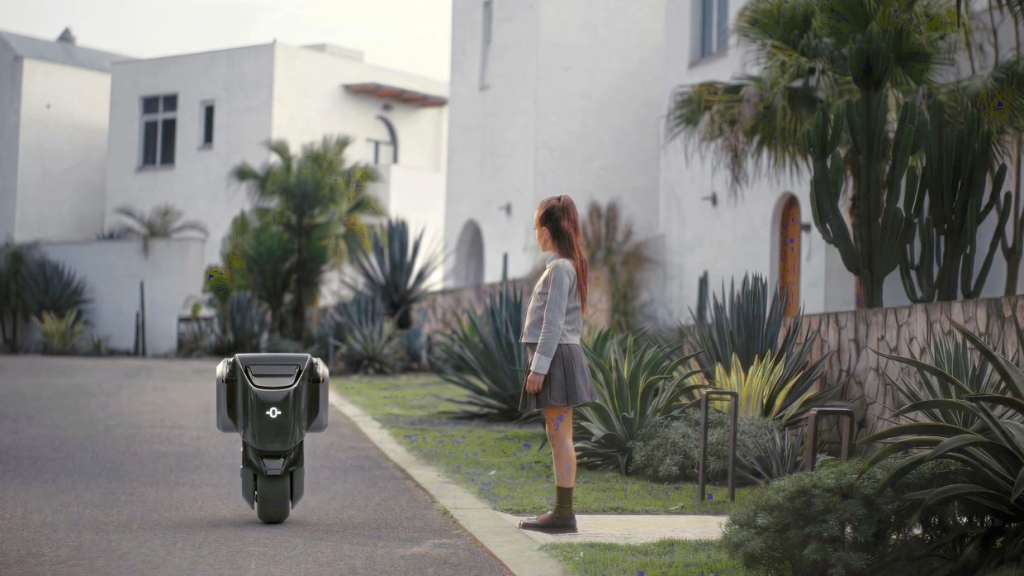
Alongside the Omo X, they introduced Mobility One: a two-wheeled delivery robot that uses the same balancing intelligence. Unlike bulky four-wheeled bots, this one is designed to slip through tight alleys, navigate doorways, and handle the messy unpredictability of real urban environments.
Even more interesting? These robots can connect to each other, scaling their capacity depending on the job.
It’s a small hint at a bigger idea: a future where the same core technology powers everything from your commute to your deliveries.
The bigger shift
Watching the Omo X in action, the takeaway isn’t just about a cool new motorcycle.
It’s about a shift in philosophy.
For decades, riding has demanded constant physical input: balance, control, endurance. The Omo X flips that equation, offering intelligence as assistance rather than replacement.
It doesn’t take away the ride. It removes the unnecessary strain.
And maybe that’s the real innovation here, not making machines that replace us, but building ones that quietly carry some of the weight.
Because if the future of transport looks like this, the humble act of staying upright might soon become the easiest part of the journey.















Facebook
Instagram
X (Twitter)
YouTube
LinkedIn
RSS