

STG Tracker’s Ducati Monster 796 Reimagined with Aerospace-Derived Forged Carbon Fibre by Argentinian Custom builders.
Subscribe to our Instagram Channel for instant news & updates!
There has always been something brutally honest about the Ducati Monster 796. No fairings to hide behind, no visual distractions, just engine, trellis frame and pure attitude on full display. The Monster wears its engineering proudly, which is exactly why it remains one of the most rewarding platforms for custom builders who believe every component must have purpose.
Interestingly, here in Malaysia, the Italian naked was once viewed as an entry-level Ducati. Compared to other models from Bologna, it was more accessible and widely seen on local roads. But affordability never meant ordinary. In the right hands, the Monster 796 still carries the aggressive DNA that made it a legend in the first place.
Argentina’s Bold Vision
Picking up sources from Pipeburn, that potential caught the attention of STG Tracker in Argentina, a workshop known across Latin America for pushing creative boundaries. Marcelo Obarrio and Germán Karp are builders who constantly chase fresh ideas, and for this project, they set their sights on something rarely seen in the motorcycle world. Their donor bike was already a perfectly proportioned street fighter, but they wanted to elevate it into something far more futuristic.
The concept was clear from the beginning. They would rebuild the Monster using forged carbon fibre, a material normally reserved for hypercars and aerospace applications. The result is a machine that looks less like a modified street bike and more like a concept vehicle that escaped from a design studio.
The Science Behind Forged Carbon
Forged carbon fibre is made from short, randomly oriented carbon strands mixed with resin and compressed under high pressure. Unlike traditional woven carbon fibre, it forms organic, marble-like patterns that make every single panel unique. The material is significantly lighter than titanium yet offers comparable strength, and because of its chopped composition, it can be moulded into far more complex shapes.
Originally developed through collaborations involving Lamborghini and advanced material laboratories, forged carbon has since become a staple in high-end automotive and aerospace engineering. Its ability to create intricate geometries with structural integrity makes it ideal for detailed three-dimensional components. For STG Tracker, it was the perfect material to redefine a naked Ducati.

Chassis and Performance Upgrades
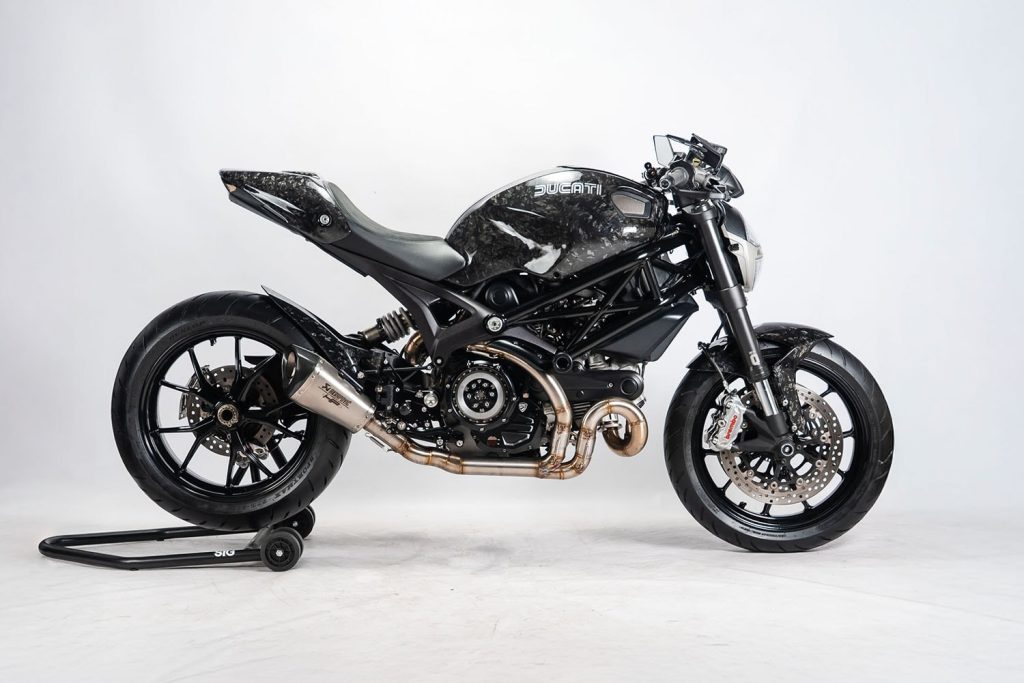
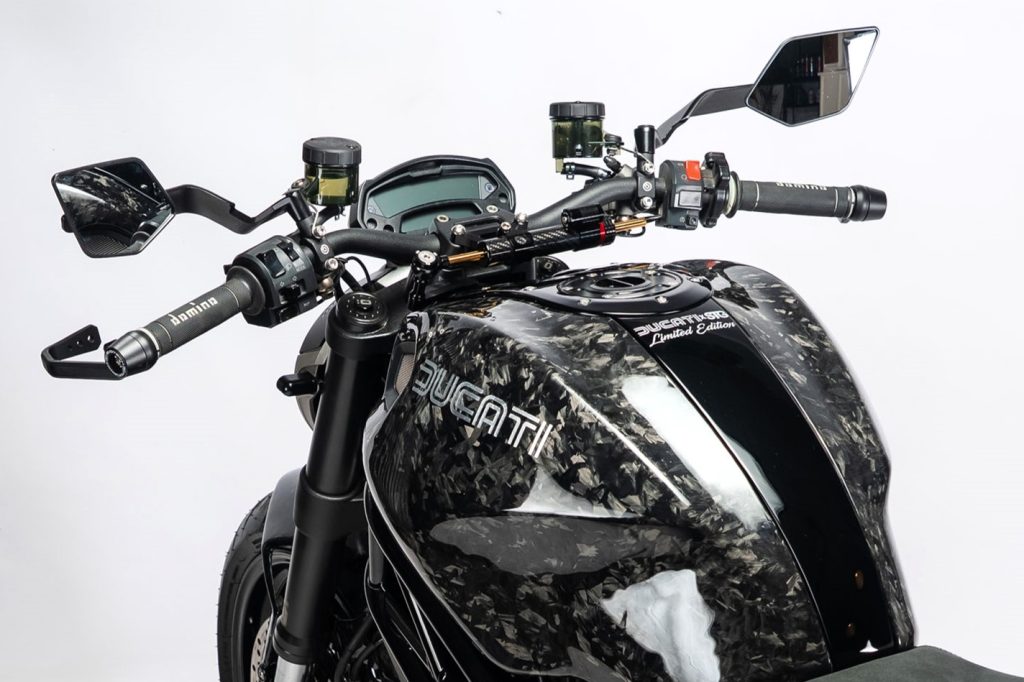
The transformation began with stripping the Monster 796 of its original bodywork. The front suspension was rebuilt using Öhlins springs and finished in black Cerakote for a stealthier presence. Up front, higher-spec Brembo brake calipers replaced the factory units, while a premium steering damper was installed to improve high-speed stability.
The cockpit remains purposeful and clean. Domino grips and Rizoma mirrors sit on the original handlebar, complemented by billet aluminium rearsets for sharper ergonomics. The wheels were powder-coated black and wrapped in Dunlop GPR300 tyres, reinforcing the bike’s aggressive street stance and more premium verdicts.
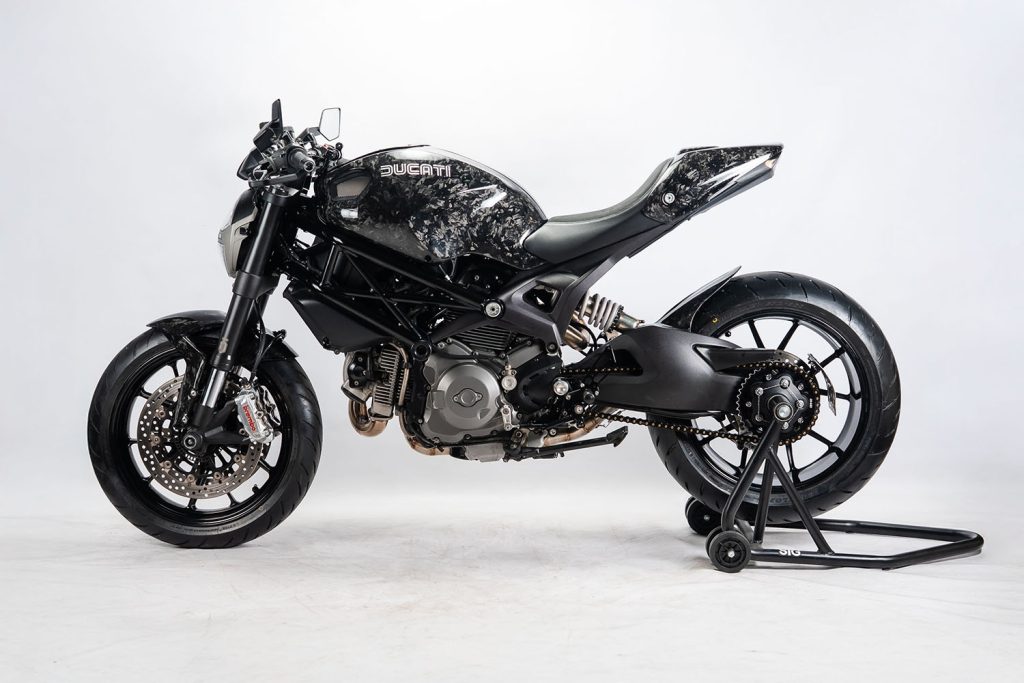
The L-twin engine that produces 87 horsepower at 8,250 rpm and also delivers 79 Nm of torque at 6,250 rpm, was largely left untouched internally, preserving its raw character. However, a custom stainless-steel two-into-one exhaust system was fabricated, ending in a high-end Akrapovic muffler. An open clutch cover proudly exposes the dry clutch assembly, adding mechanical theatre to the overall package.
Where the Real Magic Happens
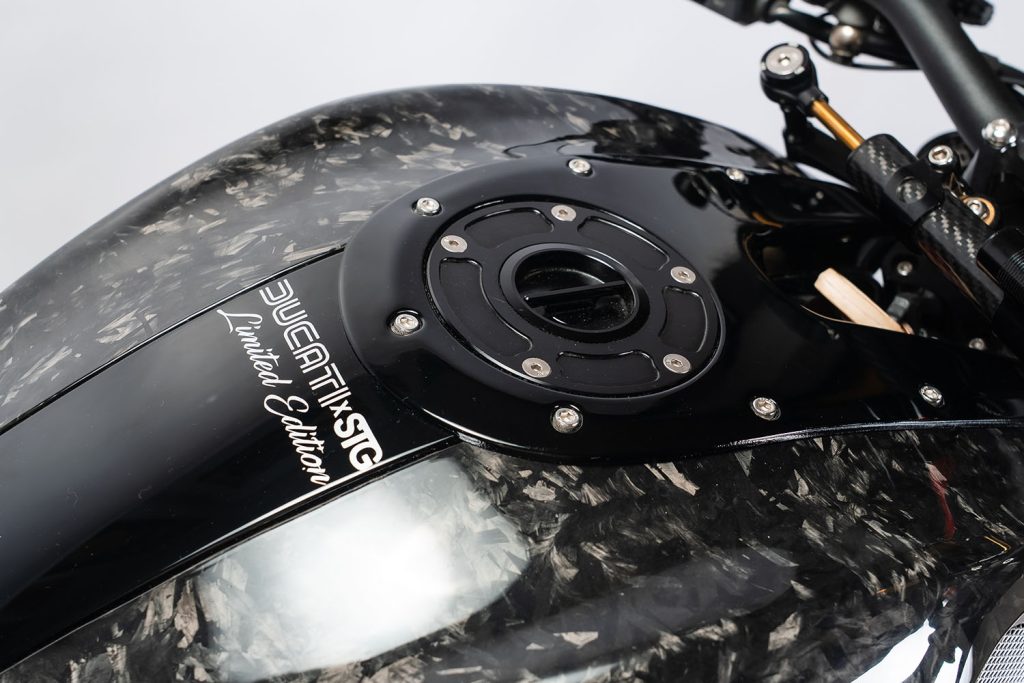
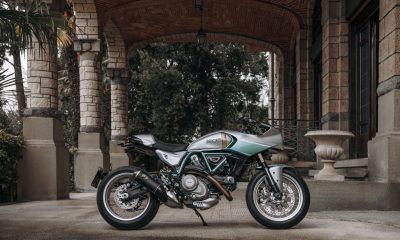
The defining feature of this build lies in its bodywork. Instead of traditional woven carbon sheets, STG Tracker recreated the original shapes using forged carbon fibre. A bespoke fuel tank mirrors the factory silhouette while showcasing the dramatic marbled texture of the material. At the rear, a carbon tail section and swingarm-mounted fender continue the theme, while a custom front mudguard completes the look.
The seat has been reworked and upholstered in a blend of black leather and Alcantara, maintaining a premium yet understated finish. The forged carbon panels were clear-coated to a deep gloss, allowing their chaotic, meteorite-like patterns to shine through naturally. Silver leaf logos applied by painter Alejandro Minissale add a subtle yet refined contrast.
Most of the remaining components were finished in black, creating a cohesive, stealth-inspired aesthetic. Against the industrial beauty of Ducati’s trellis frame, the forged carbon surfaces feel modern and technical, almost aerospace in spirit. The under-seat area was cleaned up and the key relocated to preserve a seamless silhouette.
The final result is not just a customized Monster. It is a reinterpretation of what a naked Ducati can become when advanced materials meet fearless creativity. Minimal, precise and unapologetically modern, this Monster does not shout for attention. It commands it.










Facebook
Instagram
X (Twitter)
YouTube
LinkedIn
RSS