

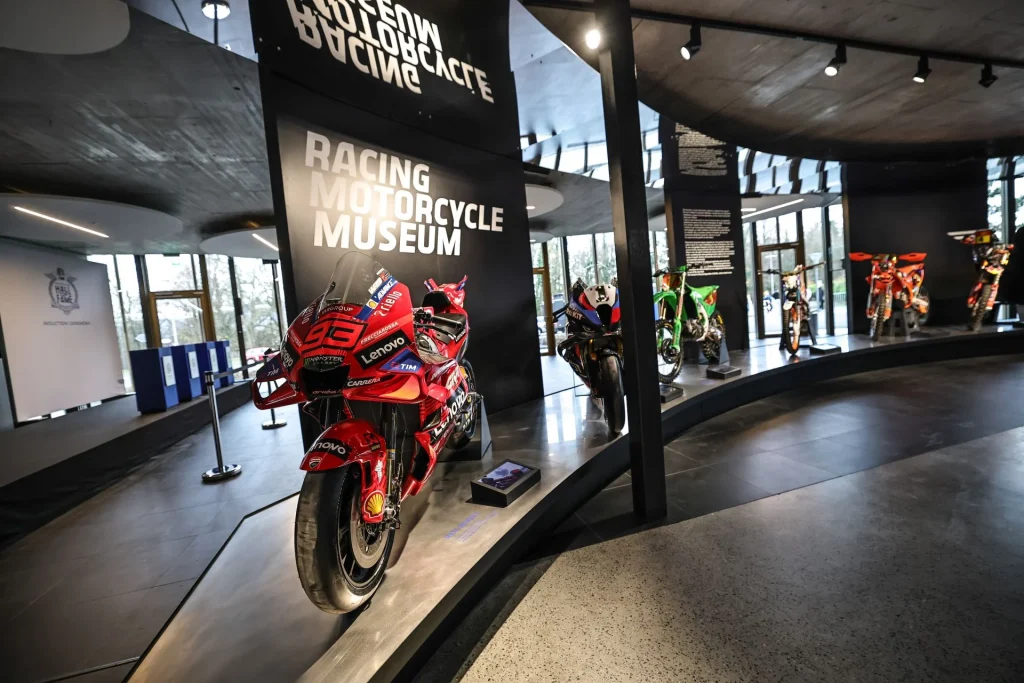
The FIM has opened a new Racing Motorcycle Museum in Switzerland, creating a permanent home for the sport’s global heritage while linking its historic legacy to the future of motorsport.

Subscribe to our Instagram Channel for instant news & updates!
Motorcycle racing has always lived at the edge of speed, risk, and innovation but until now, much of its global history existed only in scattered collections, private garages, and fading archives. That changed with the opening of the new Racing Motorcycle Museum by the Fédération Internationale de Motocyclisme in Mies, Switzerland, giving the sport a purpose-built home for its legacy.
Rather than positioning the museum solely as a tourist attraction, FIM has framed it as a living archive of competitive motorcycling, one that connects governance, technology, athletes, and fans across generations.
From rulebook to real machines
For decades, FIM has governed the technical rules, safety standards, and sporting frameworks of motorcycle competition worldwide. The new museum offers something different: a physical translation of those regulations into real machines that shaped entire eras.
Visitors walk through timelines where engineering philosophy, safety evolution, and racing formats visibly change from decade to decade. From early championship-winning machinery to today’s high-tech prototypes, the museum quietly illustrates how rule changes, safety demands, and innovation have pushed motorcycle design forward, sometimes faster than any single manufacturer ever could alone.
Today’s champions already become history
One of the most striking aspects of the collection is how quickly modern racing becomes heritage. Bikes ridden by current-era champions now sit alongside machines from motorsport’s earliest years. The effect is powerful: it shows that today’s champions are not just competing for trophies, they are actively shaping the historical arc of the sport.
Rather than separating “classic” and “modern,” the museum places them into one continuous story, reinforcing how quickly technology, riding style, and competition evolve in motorcycle racing.
More than nostalgia: a strategic cultural investment
For FIM, the museum also represents a strategic shift. Global motorsport bodies increasingly operate not just as regulators, but as cultural custodians. As sustainability, electrification, and safety dominate future competition discussions, preserving the sport’s history becomes just as important as shaping its future.
The museum acts as:
- A heritage anchor for global motorcycle sport
- A formal education space for engineers, regulators, and riders
- A symbol of continuity as racing enters new technological eras
It also strengthens Switzerland’s role as a quiet but influential centre of global motorsport governance.
Why this matters beyond Europe
Although physically located in Switzerland, the museum reflects racing stories from every major motorcycle nation from Europe and Japan to Southeast Asia, Australia, and the Americas. For fans in Asia, where motorcycle racing participation and fandom continue to grow rapidly, the museum confirms that the sport no longer belongs to one region or tradition.
It also formalises something the sport has long operated on informally: motorcycle racing is a global cultural language, not just a competition series.
A bridge between legacy and the future
As racing faces fundamental transformation, through electrification, sustainability targets, and increasing safety expectations, the museum plays a crucial balancing role. It reminds fans and officials alike that innovation has always been part of motorcycle racing’s DNA, not a recent disruption.
By preserving where the sport came from, FIM has created a clearer runway for where it is going.














Facebook
Instagram
X (Twitter)
YouTube
LinkedIn
RSS