

Roof unveils the DJagger, a radical full-face helmet with a rear-opening design that removes the need for a chin strap. Debuted at EICMA, the prototype promises easier use, better fit, and improved emergency access as it heads toward testing and certification.
Subscribe to our Instagram Channel for instant news & updates!
For years, most helmet innovation has focused on electronics, AI systems, AR displays, cameras, and connected features, while the basic structure of a motorcycle helmet has stayed largely the same. French helmet maker Roof plans to disrupt that status quo with its boldest concept yet: the DJagger, a full-face helmet that eliminates the traditional chin strap altogether.
A New Way to Wear a Helmet
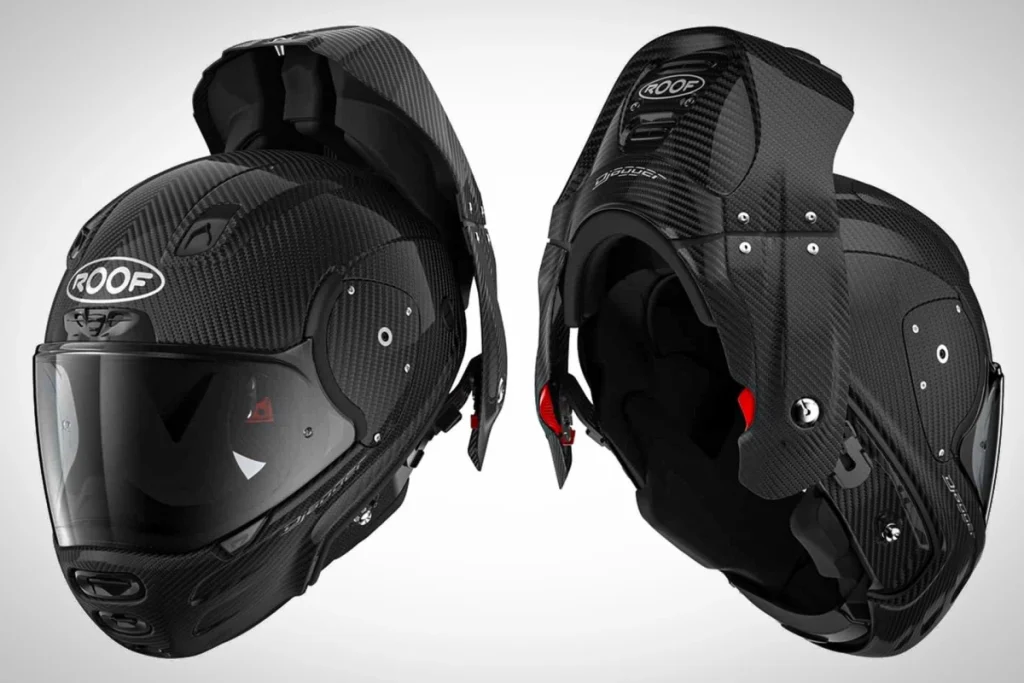
Roof, founded in 1993 and now distributed in over 35 countries, has built its reputation on unconventional ideas. The DJagger continues that tradition with a mechanism unlike anything currently on the market. Instead of a chin strap, the helmet’s entire rear section opens laterally, swings backwards, and lifts outward, creating a wide entry space for the rider’s head.
The motion is futuristic, visually reminiscent of an Iron Man helmet, and allows the helmet to be worn without removing gloves, sunglasses, or prescription glasses. Because it slips over the face rather than down over the head, eyewear stays firmly in place.
Comfort and Emergency Access
Roof claims the DJagger offers improved acoustic insulation and a more precise fit thanks to its unique architecture. The design also provides practical benefits in emergency situations. First responders would be able to access the rider’s face without the upward pulling motion typical of conventional helmets, potentially reducing strain on the rider’s neck after a fall.
Technology on the Horizon
If the DJagger reaches production, Roof plans to offer a photochromic visor that adjusts automatically to lighting conditions and a Pinlock insert for fog prevention. However, before any features are finalised, the helmet must meet the stringent ECE 22.06 safety certification, no small task for a design with moving structural components.
Questions That Remain
Despite its promise, the DJagger raises several concerns. The most immediate is the durability and reliability of its hinge mechanism. Riders are already wondering whether the system is mechanical or electronically assisted, and how it might hold up under repeated use. Adding moving parts to a safety-critical item introduces potential points of failure, and the idea of a hinge malfunction trapping a rider inside the helmet is understandably unnerving.
There are also questions about structural integrity. Traditional helmets use a solid shell and a secure chin strap to manage impact forces; rethinking that formula requires exceptional engineering to ensure equivalent protection. And finally, the helmet market is heavily driven by brand trust. Riders loyal to Arai, Shoei, Bell, or AGV may need strong convincing before embracing such a radical departure from convention.
Still a Prototype For Now
Revealed at this year’s EICMA, the DJagger remains a prototype with no confirmed release date or price. Rumours suggest Roof is actively testing the design, but its path to production depends largely on certification success and real-world durability.
Whether it becomes a genuine breakthrough or a niche experiment, the DJagger represents one of the most ambitious attempts in recent years to rethink the motorcycle helmet. In an industry where safety gear evolves cautiously, Roof’s willingness to challenge long-standing norms has undoubtedly captured attention.



















Facebook
Instagram
X (Twitter)
YouTube
LinkedIn
RSS